
0
Aller directement au contenu
Extraits de « Xxijra Hii »
Parcourir les avant-premières du moment
Contact
Retour à la page d'accueil 🚪
Français
Extraits de « Xxijra Hii »
Parcourir les avant-premières du moment
Contact
Retour à la page d'accueil 🚪
Français
Parcourir les avant-premières du moment
Contact
Retour à la page d'accueil 🚪
Français
Retour
Inventory › Aaron Ford | Untitled (glass piece) i

Aaron Ford | Sans titre (œuvre en verre) i

£2,800.00

Untitled (glass piece) i

Oil on glass, Murex shells

90 x 122 cm

2025

£2,800 GBP

Renseignez-vous ici

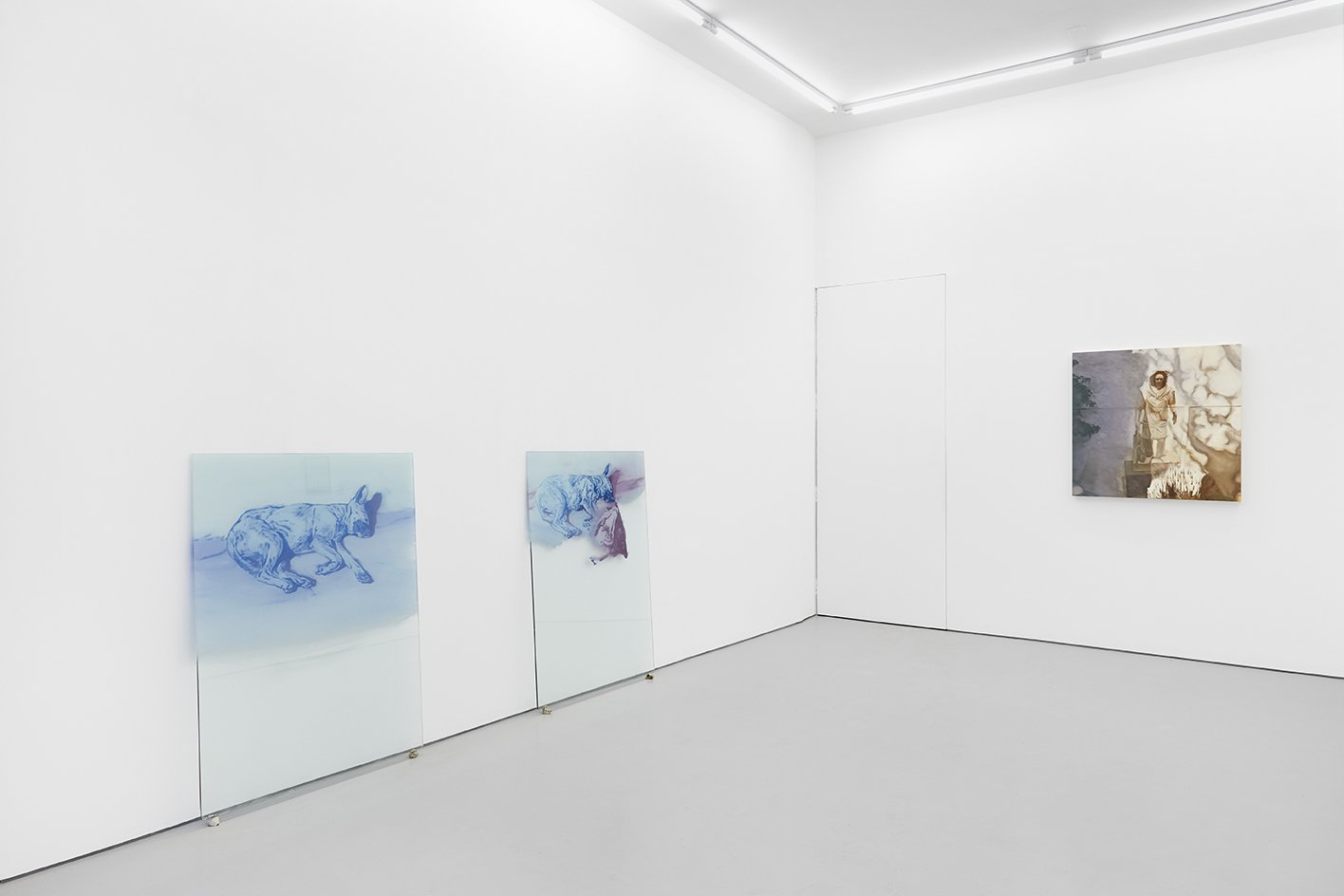
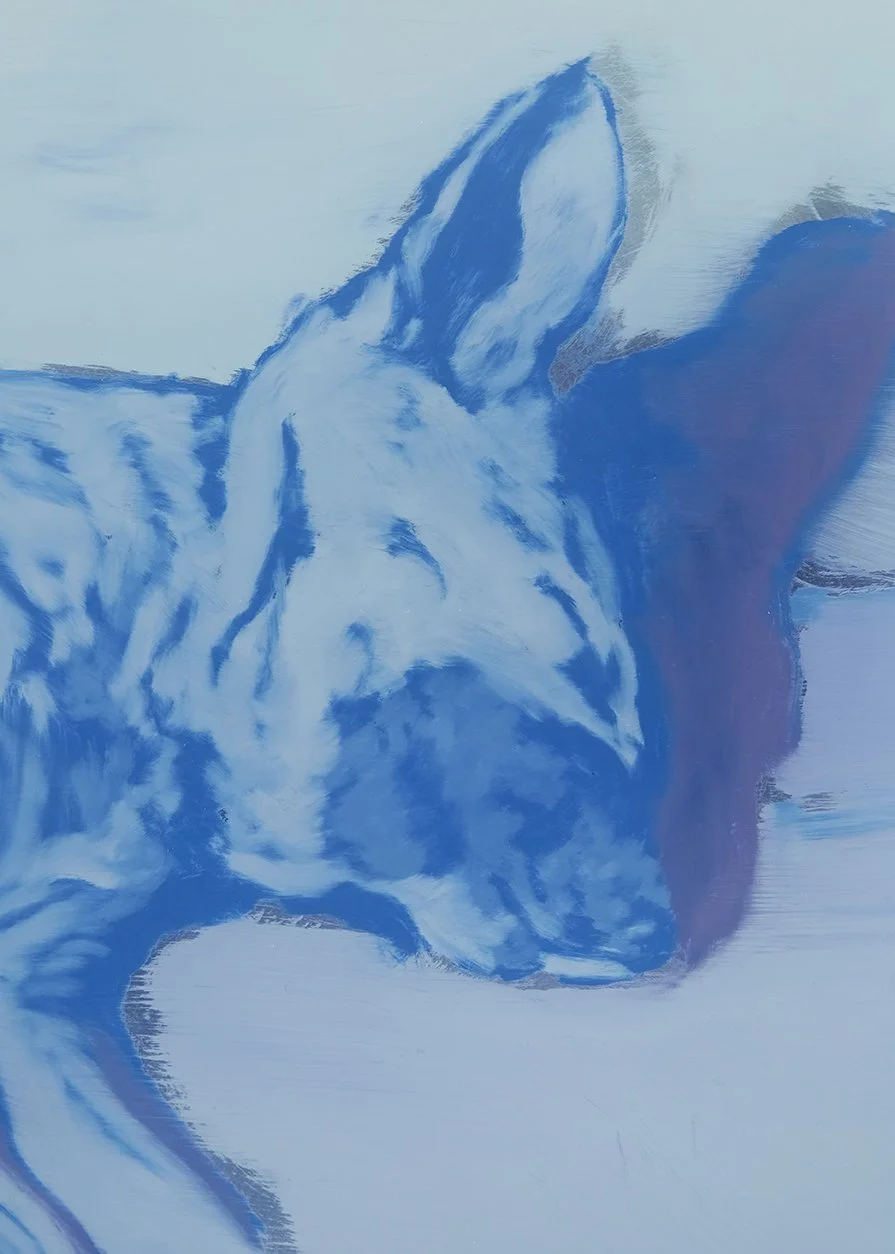
Aaron Ford’s painted sheets of glass, resting delicately on Murex shells, echoes the ancient origins of Tyrian purple. Once reserved for the elites of Carthage and Rome. Using layered washes of blue and purple tones, the work gestures toward the movement of both pigment and power across time, tracing how a single colour became a marker of status, empire, and control.

The Murex shells beneath the glass recall the legend of Tyrian purple’s discovery, famously depicted in Peter Paul Rubens’ The Discovery of Purple by Hercules’s Dog (c. 1636). In the myth, Hercules' dog bit into a sea snail, staining its mouth with the deep purple hue. This chance encounter led to the dye’s prized use by nobles; an association that migrated across cultures and civilisations, much like the people and icons Ford’s work reflects upon.

Suspended between fragility and resilience, the glass suggests both the fleeting nature of power and the persistence of histories embedded in materials. By resting on the very shells that once produced imperial purple, Ford’s work collapses past and present, questioning how symbols of status and identity continue to shift over time.

Tyrian purple, has its origins along the Mediterranean coast, with both Tyre (in present-day Lebanon) and regions of Tunisia, including Djerba and Carthage, serving as key centres of its production. The dye was derived from the secretions of the Murex sea snail, which thrived in these coastal waters. Tyre became renowned for refining and monopolising this labor-intensive process, giving the dye its name, but Carthage (founded as a Phoenician colony by settlers from Tyre) became another major hub of production and trade. As Carthage rose to power, it inherited and expanded the dye industry, embedding it within broader networks of Mediterranean commerce. With Rome’s conquest of Carthage in 146 BCE, control of the dye trade shifted, and Tyrian purple became a marker of imperial authority, worn exclusively by Roman elites. Tunisia’s historical role in producing this coveted pigment thus ties it directly to the broader movement of power, culture, and colonisation across the Mediterranean, from Phoenician trade routes to Roman imperialism and beyond.

Untitled (glass piece) i

Oil on glass, Murex shells

90 x 122 cm

2025

£2,800 GBP

Renseignez-vous ici

Aaron Ford’s painted sheets of glass, resting delicately on Murex shells, echoes the ancient origins of Tyrian purple. Once reserved for the elites of Carthage and Rome. Using layered washes of blue and purple tones, the work gestures toward the movement of both pigment and power across time, tracing how a single colour became a marker of status, empire, and control.

The Murex shells beneath the glass recall the legend of Tyrian purple’s discovery, famously depicted in Peter Paul Rubens’ The Discovery of Purple by Hercules’s Dog (c. 1636). In the myth, Hercules' dog bit into a sea snail, staining its mouth with the deep purple hue. This chance encounter led to the dye’s prized use by nobles; an association that migrated across cultures and civilisations, much like the people and icons Ford’s work reflects upon.

Suspended between fragility and resilience, the glass suggests both the fleeting nature of power and the persistence of histories embedded in materials. By resting on the very shells that once produced imperial purple, Ford’s work collapses past and present, questioning how symbols of status and identity continue to shift over time.

Tyrian purple, has its origins along the Mediterranean coast, with both Tyre (in present-day Lebanon) and regions of Tunisia, including Djerba and Carthage, serving as key centres of its production. The dye was derived from the secretions of the Murex sea snail, which thrived in these coastal waters. Tyre became renowned for refining and monopolising this labor-intensive process, giving the dye its name, but Carthage (founded as a Phoenician colony by settlers from Tyre) became another major hub of production and trade. As Carthage rose to power, it inherited and expanded the dye industry, embedding it within broader networks of Mediterranean commerce. With Rome’s conquest of Carthage in 146 BCE, control of the dye trade shifted, and Tyrian purple became a marker of imperial authority, worn exclusively by Roman elites. Tunisia’s historical role in producing this coveted pigment thus ties it directly to the broader movement of power, culture, and colonisation across the Mediterranean, from Phoenician trade routes to Roman imperialism and beyond.

Demander des informations
  • Je suis une artiste et chercheuse qui s'intéresse à la manière dont les migrations influencent notre compréhension de l'art. Récemment, je me suis appuyée sur la production, la circulation et l'héritage de l'ancien pigment, la pourpre de Tyr, à travers la Méditerranée, comme métaphore pour analyser les structures de pouvoir présentes dans la région au fil de l'histoire.  

    En explorant les procédés d'extraction nécessaires à la synthèse de ce pigment et ses implications ultérieures en tant que symbole de la Rome impériale, j'aborde parfois l'héritage colonialiste de l'Europe en Afrique du Nord, tout en reconnaissant le potentiel de l'art à offrir un moyen d'action pour le passé, le présent et l'avenir.

    -

    Dans le cadre de ma pratique, je mène des recherches collaboratives et discursives, qui sont ensuite synthétisées dans mon atelier sous forme de matériel visuel présenté à travers différents supports, tels que le verre, la peinture et des œuvres textuelles.

     Je m'appuie sur une conception de la migration iconographique telle que l'a définie l'historien d'art allemand Aby Warburg. Je recherche des signes ou des symboles récurrents, en prenant l'image peinte comme point de référence. Le moteur interdisciplinaire qui en résulte dans ma pratique correspond à ce que Warburg décrit comme « une tour d'observation [qui] surplombe toutes les routes migratoires des échanges culturels ». 

  • Né en 1994 à Londres, en Angleterre

     Vit et travaille à Londres

    Éducation

     2013-2017, Licence (avec mention) en beaux-arts, Central St Martins, UAL, Londres

     2012-2013, Diplôme préparatoire en art et design, Central St Martins, UAL, Londres

     Sélection d'expositions collectives :

    2024, « Home and Away », Galerie 2,Matt Carey-Williams,Séoul, Corée du Sud

    2024, Tu n'as pas fermé l'œil de la nuit, British School at Rome, Italie

    2023, « Perfect Passive », Galerie Xxijrah Hii, Londres

    2023, Horizon Line, Galerie Andrew Reed, Miami, États-Unis

    2023, À la pointe de la mode, Rose Easton, Londres

    2022, « Tree and Leaf », Galerie Hannah Barry, Londres

    2021, « Triggered Economics » ou Comment s'engager face à l'inévitable, 34 Bruton Street, Londres

    2020, WDT 1:1, Wetdovetail, en ligne 

    2019, Mention « Exceptionnel » : Prix d'art des jeunes diplômés de la galerie Collyer Bristow, galerie Collyer Bristow, Londres

     2019, Four Good Eggs, bénéficiaire de Brixton, Londres

     2018, « Paper Cuts » de Kristian Day, Saatchi Gallery, Londres

    Résidences :

    Bourse Sainsbury, École britannique de Rome, septembre 2023 - mars 2024

    Retraite créative à Xenia, février - avril 2022

    Événements, tables rondes et débats :

    Michael Armitage s'entretient avec Aaron Ford, à l'École britannique de Rome, 2024

    « Négocier l'héritage italien », Université NABA et On-Site Roma, Rome, mai 2024

    CRIT n° 33 – Programme public, CASTRO Projects, Rome, janvier 2024

    Conférence d'introduction, École britannique de Rome, octobre 2023, janvier 2024 

Xxijra Hii est une galerie située à Londres, au Royaume-Uni

Contactez-nous à l'adresse info@xxijrahii.net

Rendez-vous sur notre site web principal

Ouvert le vendredi et le samedi de 12 h à 18 h ou sur rendez-vous

50 Resolution Way, Londres SE8 4AL